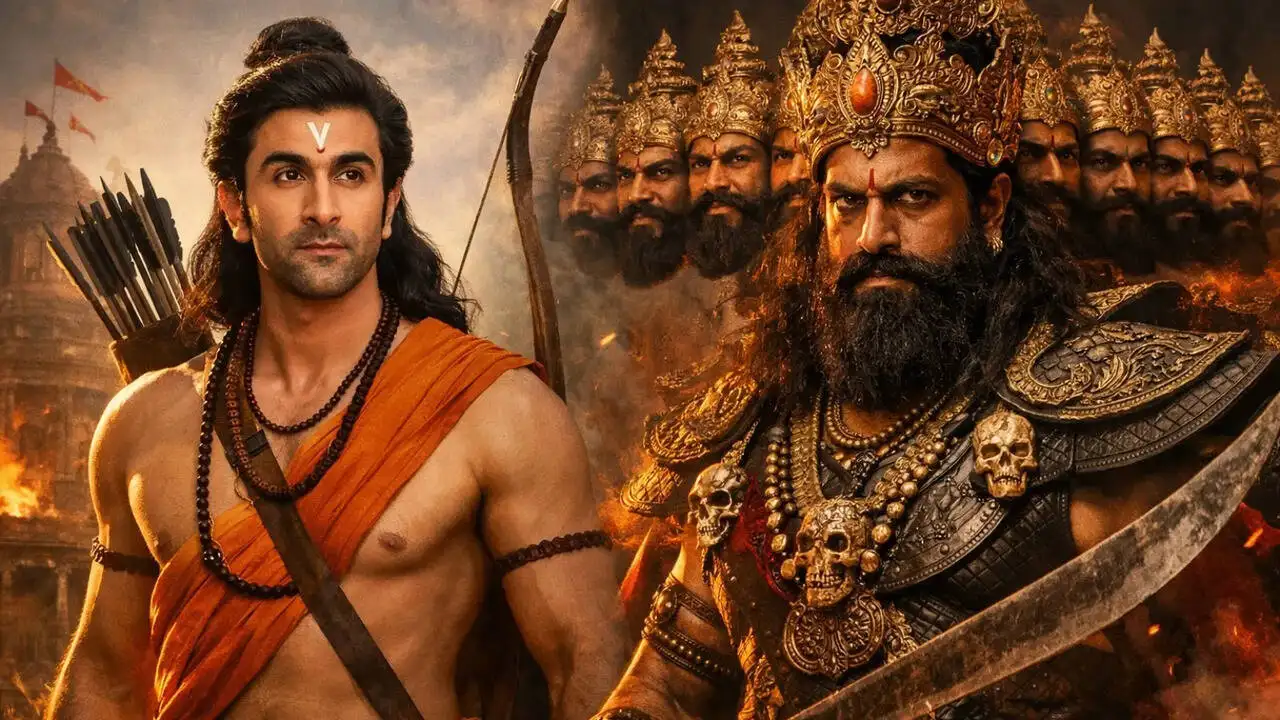
A Hollywood veteran who spent over two decades shaping global cinema just made one of the boldest predictions in Bollywood history. John Fithian — former President and CEO of the National Association of Theatre Owners (NATO) and now the global distribution strategist behind Ramayana — says the Nitesh Tiwari epic will become “the first Indian global theatrical blockbuster ever.”
This is not a fan on Twitter speculating. This is the man who helped navigate Hollywood through 9/11, the digital transition, the rise of streaming, and a global pandemic. When he makes a prediction about cinema, the industry sits up and listens.
Who Is John Fithian and Why Does His Prediction Matter?
John Fithian is one of the most respected names in global theatrical exhibition. He served as President and CEO of the National Association of Theatre Owners (NATO) for over two decades — from January 2000 until his retirement in 2023 — making him one of the longest-serving and most influential figures in movie theater history worldwide.
After leaving NATO, Fithian co-founded The Fithian Group, LLC, alongside former NATO colleagues Patrick Corcoran and Jackie Brenneman. The consultancy specialises in helping productions build their footprint across the global distribution and exhibition ecosystem. When Ramayana‘s producer Namit Malhotra came calling, Fithian signed on as the film’s global distribution partner.
This is not someone throwing around buzzwords. This is a man who spent 20+ years negotiating with the biggest exhibitors on Earth and knows exactly what a global theatrical hit looks and feels like.
What Exactly Did John Fithian Say About Ramayana?
Fithian made his prediction in a LinkedIn post following CinemaCon 2026 — the film industry’s biggest annual gathering in Las Vegas. His words were confident, specific, and grounded in what he witnessed firsthand.
He wrote: “All the most important theatrical exhibition companies from the U.S., Canada, the Caribbean, Latin America, Europe and Australia scheduled and attended private meetings in the Ramayana demonstration ballroom and theater, where Namit showed them never-before seen clips of the movie, with never-before used technologies and special effects, and learned from those leading western cinema operators how best to market, distribute and exhibit the movie in their territories.”
He then concluded: “Having witnessed those conversations, I can now predict that Ramayana (in two parts) will become the first Indian global theatrical blockbuster ever. See you at the movies!”
This was not pre-CinemaCon hype. This was a post-event statement made after watching the reactions of the world’s most powerful theatrical exhibitors in real time. That context matters enormously.
What Happened at CinemaCon 2026 That Made Fithian So Confident?
CinemaCon, held annually at Caesars Palace in Las Vegas, is where Hollywood studios pitch upcoming films to theater owners and distributors from around the world. It is, simply put, the most important room in global cinema every year.
Ramayana didn’t just attend CinemaCon 2026 — it dominated it. The team set up a dedicated demonstration ballroom — the Milano III — where exhibition executives from North America, Latin America, Europe, and Australia came for private screenings of never-before-seen footage, shown with cutting-edge technologies and VFX that reportedly left the room stunned.
According to Reuters, Ramayana posters were displayed at CinemaCon alongside promotions from the biggest Hollywood franchises. That alone is a statement. Indian films don’t typically share real estate with Marvel or DC at the world’s premier cinema convention. This one did.
Producer Namit Malhotra’s quote from the event sets the tone perfectly: “We’re making the largest film in the world for the greatest epic that deserves to be seen globally.”
What Is the Ramayana Film? The Full Story Behind India’s Most Ambitious Production
Here are the facts — and they are genuinely staggering.
Director: Nitesh Tiwari, who spent over seven years developing the project. His credits include Dangal (2016), one of the highest-grossing Indian films of all time.
Producer: Namit Malhotra’s Prime Focus Studios, in association with 8-time Oscar-winning VFX house DNEG (known for Dune, Interstellar) and Yash’s Monster Mind Creations.
Cast:
- Ranbir Kapoor as Lord Rama
- Sai Pallavi as Sita
- Yash as Ravana
- Sunny Deol as Hanuman
- Ravi Dubey as Lakshmana
- Amitabh Bachchan as Jatayu/narrator
- Lara Dutta as Kaikeyi
- Kajal Aggarwal, Rakul Preet Singh, Arun Govil, Kunal Kapoor in supporting roles
Music: A.R. Rahman and Hans Zimmer — their first-ever collaboration in film history. Two Oscar winners, one score, one epic. The musical possibilities are almost impossible to overstate.
Budget: According to Variety, the combined two-part budget is approximately $500 million — placing it among the most expensive film projects ever made, anywhere in the world.
Release: Both parts are shot for IMAX worldwide. Part 1 releases on Diwali 2026 (November 8, 2026). Part 2 follows on Diwali 2027.
Story: Based on Valmiki’s ancient Sanskrit epic, the film follows Prince Rama’s exile, his wife Sita’s abduction by the demon king Ravana, and the legendary battle that follows. The tagline says it all: “Our Truth. Our History.”
Why Is This the Right Moment for Indian Cinema to Go Global?
The timing of Ramayana is not accidental. Several converging trends suggest Indian cinema is finally positioned — technically, culturally, and commercially — to break through on a genuinely global scale.
1. The Indian diaspora is larger than ever. According to the Ministry of External Affairs, India has the world’s largest diaspora, with over 32 million people of Indian origin living outside the country. That is a built-in global audience for a story they have grown up hearing.
2. RRR and KGF opened the door. S.S. Rajamouli’s RRR (2022) won the Academy Award for Best Original Song and grossed over $130 million worldwide. KGF: Chapter 2 (2022), starring Yash himself, grossed over ₹1,200 crore globally. These were proof-of-concept moments. Ramayana aims to be the full realisation of that concept.
3. Global OTT platforms have built the audience. Netflix, Amazon Prime Video, and Disney+ have spent billions distributing Indian content to Western audiences over the past decade. Millions of non-Indian viewers around the world are now familiar with Indian storytelling — lowering the discovery barrier for a theatrical release.
4. The VFX quality is now world-class. DNEG — the same studio behind the Oscar-winning effects in Dune and Interstellar — is handling the VFX for Ramayana. The “Adipurush problem” (poor VFX in a Ramayana-adjacent film in 2023) will not repeat here.
What Does Yash Say About Making Ravana Relatable for a Global Audience?
This is where the creative ambition of Ramayana becomes especially interesting. Yash — the KGF superstar and a co-producer on the film — spoke at CinemaCon about the specific challenge of playing Ravana for a Western audience that may not already know or love the character.
In an interview with Reuters, he said: “I have tried to internalize the whole essence of Ravana and tried to make him as human as possible at times. It’s important for people to relate to him, especially since we have global ambitions, so we need to make it familiar to a Western audience as well.”
This is smart storytelling strategy. Great epics don’t just need heroes — they need villains with depth. And Ravana, in the original Valmiki text, is one of literature’s most complex antagonists: brilliant, devoted, powerful, and ultimately undone by one fatal flaw. Making him human rather than cartoonishly evil is exactly the right instinct.
How Is Ramayana Being Distributed Globally?
The distribution architecture for Ramayana is deliberately designed to mirror how Hollywood blockbusters operate — not how Indian films typically reach international markets.
Prime Focus Studios will handle theatrical distribution in India. For the international market, The Fithian Group has been meeting with the major exhibition circuits across North America, Latin America, Europe, and Australia to establish territory-by-territory partnerships. This is a ground-up theatrical distribution approach — the kind that gives the film the widest possible screen count and marketing support in each region.
The film’s CBFC certification of “U” (Universal) — confirming it is accessible to all age groups — is a deliberate strategic decision to maximise family and cross-demographic reach globally.
The makers are also reportedly investing heavily in dubbing and localisation across multiple languages to remove the subtitle barrier that has historically limited Indian films in Western markets.
What Are the Challenges Ramayana Still Has to Overcome?
To be fair — and a good SEO article should be — the road to becoming the first Indian global theatrical blockbuster is not without obstacles.
Cultural familiarity gap: Ramayana is not yet the globally recognised IP that Marvel, Star Wars, or Harry Potter are in the West. Even with 32 million diaspora members as a built-in base, the film still needs to pull mainstream Western audiences who have no prior emotional attachment to the story.
The Adipurush shadow: A 2023 Ramayana-adjacent film by Prabhas faced significant backlash — particularly for its VFX quality. That film’s failure has raised expectations and scrutiny for any visual interpretation of this sacred epic. The Ramayana team is clearly aware of this, which is why the involvement of DNEG is so strategically important.
Sheer scale of ambition: $500 million is a massive bet. Even for Hollywood, this budget bracket requires a near-certain global hit to break even. The pressure is enormous — and the margin for error is slim.
That said, none of these challenges have dampened John Fithian’s confidence — and he has seen a lot more failure and success in this industry than most.
What Happened With the Music? The AR Rahman–Hans Zimmer Partnership Explained
Let’s not skip past this, because it deserves its own moment.
A.R. Rahman is a two-time Academy Award winner (for Slumdog Millionaire, 2009) and is widely considered the greatest film composer in Indian history. Hans Zimmer is also a two-time Academy Award winner, responsible for some of the most iconic scores in cinema history — from The Lion King to Gladiator to Inception to Dune.
According to IMDb, this marks the first time these two composers have collaborated on a film together. Not for a Bollywood film. Not for a crossover project. The first time — period. For Ramayana.
The choice is clearly intentional. If you want Western audiences to emotionally connect with an ancient Indian epic, a Hans Zimmer score wrapping around A.R. Rahman’s melodies is perhaps the single most powerful musical bridge imaginable between those two worlds.
Final Verdict: Is Fithian Right? Could Ramayana Actually Make History?
The honest answer is: we will know in November 2026. But the conditions have never been more favourable.
Consider what Ramayana has that no previous Indian film has had simultaneously: a $500 million budget, IMAX worldwide release, a dedicated global distribution partnership led by a former NATO CEO, the first-ever AR Rahman–Hans Zimmer collaboration, DNEG on VFX, a cast that combines Bollywood and pan-Indian superstardom, a story that 1.4 billion Indians hold sacred, a 32-million-strong diaspora ready to fill seats opening weekend, and the most powerful theatrical exhibitors on Earth already in the room, already watching the footage, already making deals.
The Ramayana story has survived over 5,000 years. It has been retold in over 300 versions across Asia, Southeast Asia, and the world. It was never a question of whether the world was ready for it. It was always a question of whether Indian cinema was ready to tell it at this scale.
Based on what John Fithian saw at CinemaCon 2026, Indian cinema finally is.
Sources: Bollywood Hungama, Reuters, Variety, Screen Daily, Screen International, IANS, IMDb, Asianet Newsable, LinkedIn (John Fithian), Ministry of External Affairs India.